Philips Sets New Standards in CT Simulation with Launch of Rembra RT and Areta RT Systems
At the 67th annual meeting of the American Society for Radiation Oncology (ASTRO) meeting in San Francisco, CA, Philips Healthcare unveiled its next-generation CT simulation platforms—Rembra RT* and Areta RT*—designed to elevate speed, accuracy, and efficiency in cancer treatment planning.
Rembra RT and Areta RT were built to address the growing demand for precision and consistency in oncology, where staffing and resource pressures often stretch care teams. The systems introduce significant advances in imaging and workflow, including a wide 85 cm extended field of view and next-generation 4DCT imaging that captures a full respiratory cycle in a single scan, accommodating breath rates of 4–40 breaths per minute. Ultra-fast image reconstruction—up to 106 images per second—and easy-to-use touchscreen gantry controls streamline operations and improve consistency across technologists. Philips notes that these features have helped 91% of care teams work more efficiently.
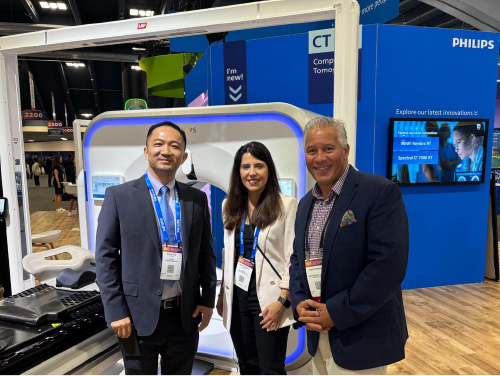
Dan Xu, Global Leader, CT, Joleen Rodriques, Head of Marketing for CT, both from Philips Healthcare pictured with Kieran Anderson, Group Publisher, Applied Radiation Oncology.
Dan Xu, Global Business Leader of CT at Philips, emphasized the significance of this launch: “Philips invented CT simulation and introduced the industry’s first big bore RT system. With Rembra RT and Areta RT, we’re once again setting new standards in radiation therapy, empowering care teams with the precision, dependability, and speed they need to deliver the best outcomes for patients.”
From a design perspective, the systems are engineered for long-term value. Philips offers its industry-first Tube for Life guarantee, while the platform is designed with a service horizon of up to 20 years, assuming upgrades and maintenance are in place. Patients benefit as well, with faster workflows that reduce waiting times, flexible table positioning, and in the case of Rembra RT, shared-use radiology capabilities to maximize department efficiency.
In a conversation with Applied Radiation Oncology, Xu underscored additional advantages: the new, high-definition detector that enhances image quality, and the OnPlan patient-side controls that improve comfort while minimizing disruptions in the workflow. “These are the sickest patients—you want to interact with them directly and make them more comfortable, while avoiding hiccups that come from remote-only controls,” he noted.
Joleen Rodrigues, Head of Marketing for CT at Philips, highlighted customer reactions: “The customers that we’ve spoken to are very excited, especially because the system offers expanded capabilities, more accuracy, and better outcomes for patients. They also have peace of mind knowing the system is scalable and designed to remain current for 20 years.”
Philips is also collaborating with MVision AI to explore integrating Contour+, an AI-powered auto-segmentation tool, into its CT simulators. This solution promises fast, precise delineation of organs at risk and lymph node areas, further enhancing radiation therapy planning.
Together, the Rembra RT and Areta RT platforms demonstrate Philips’ commitment to innovation in oncology, setting a new benchmark for CT simulation that blends speed, accuracy, patient focus, and long-term reliability.
* The Rembra RT and Areta RT CT System are 510(k) pending in the U.S.